


Bricks breaker ace
PalebluedotStudio
I spent time with Bricks breaker ace as a quick arcade game built around one clear action: aim a ball, release it, and break blocks. That simplicity is its strongest first impression. I did not need a tutorial-heavy introduction or a long setup before playing; the idea is immediately understandable, which makes it easy to pick up during a short break. At the same time, the straightforward design means the quality of each attempt depends heavily on how satisfying you find repeated aiming, bouncing, and clearing.
PalebluedotStudio presents the game as a free arcade experience for Everyone, and it fits that description comfortably. It is available for devices running Android 8.0 or later, with version 1.7.1 being the current version I reviewed. The game has reached over 500 thousand installs and holds a 4.1 average from around 2 thousand ratings, so it has clearly found an audience among players who enjoy compact brick-breaking sessions rather than large, story-driven games.
How the early goals turn a simple shot into a real decision
The first few moments are about learning the relationship between angle and outcome. Shooting directly at the nearest block may produce an immediate hit, but the more useful question is where the ball will travel after the first collision. A good opening shot can touch several blocks, return from a wall, and continue working while I wait for the next turn. That gives the game more thought than its one-line premise might suggest.
I found it helpful to stop treating each block as an isolated target. The real early goal is to create a route. I look for a side angle that sends the ball through a crowded area, then consider whether the return path will reach blocks that are otherwise awkward to hit. This small change in thinking makes the opening stages feel less like random tapping and more like a compact geometry puzzle inside an arcade format.
That approach also makes the game approachable for different kinds of players. Someone who only wants a few seconds of action can fire quickly and enjoy the immediate feedback. Someone willing to pause before a shot can search for a better chain of impacts. I appreciate that the basic rules do not force a complicated learning curve, while the bouncing behavior gives careful players something to improve.
Related News

Threads in Real Life: Who Should Join, Lurk, or Leave

How SHEIN Turned Shopping Into an Endless Content Feed

How to Make Fortnite Feel Smarter on Mobile

Should You Switch to Microsoft Outlook on Mobile?

Why Gallery Keeps Pulling Users Back

X Review: Why Its Network Still Matters
In an everyday situation, I can see myself opening it while waiting for a coffee or sitting on public transport. One attempt is easy to start without committing to a long session. If I have more time, I can continue trying to improve the next shot rather than needing to remember a plot, manage equipment, or return to a complicated menu. That makes it more convenient than many arcade games that bury their main action under progression screens.
Why the angle matters more than speed
The most useful practical tip is to aim for the first collision that creates the best follow-up path, not simply the block that looks closest. A shallow angle along a wall can sometimes be more valuable than a direct shot because it keeps the ball active across a wider area. I also try to avoid launching without checking where the ball is likely to return. A powerful-looking opening can be disappointing if it leaves the next opportunity poorly positioned.
This is where the game’s early goals become self-directed. I am not only trying to remove blocks; I am trying to make the next launch easier. That creates a modest but genuine sense of planning. The game does not need a large set of abilities to offer this kind of decision-making. Its challenge comes from reading the layout and accepting that a safe shot and an ambitious shot can lead to very different results.
Gallery
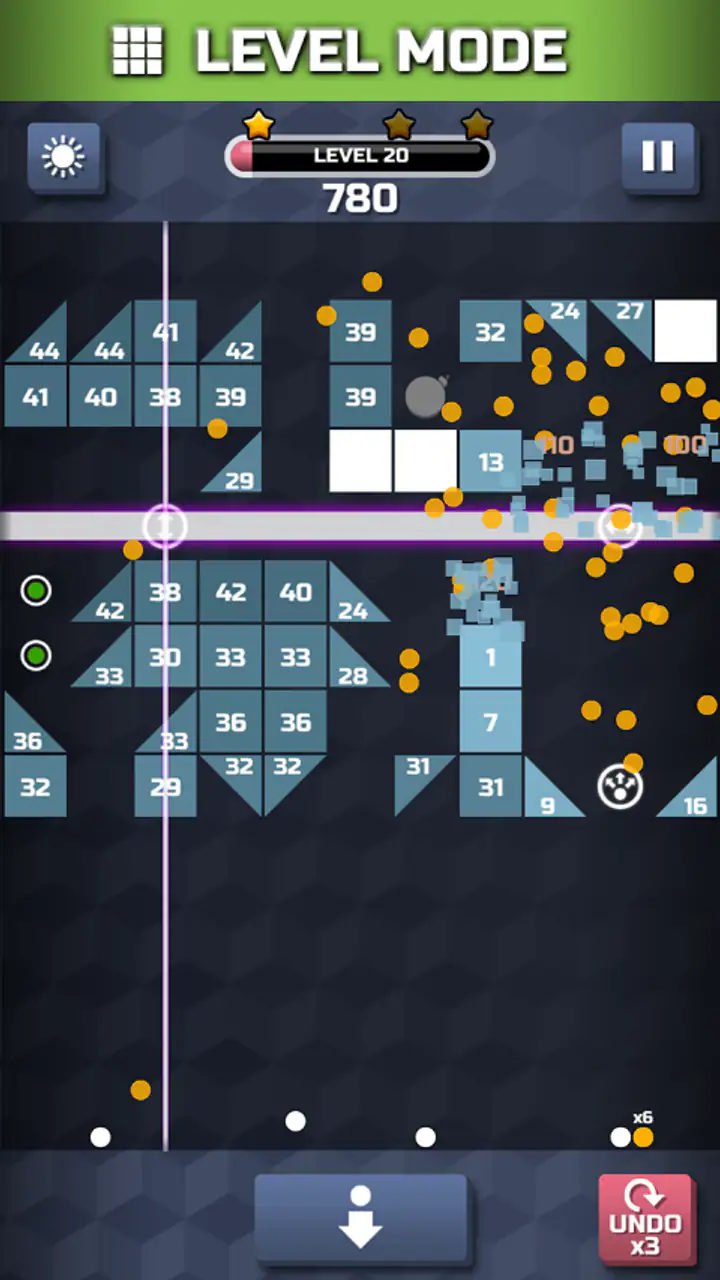
Players who expect an extensive tutorial, character upgrades, or a narrative reason to keep going may find the opening too bare. The appeal is concentrated in the shot itself. For me, that is a positive when I want uncomplicated play, but it also means the game has to keep the physical feedback and level rhythm satisfying because there are fewer surrounding systems to distract from repetition.
Progress signals, challenge, and the rhythm of continuing
The progression experience is best understood through what happens on the playfield rather than through a broad adventure structure. Each cleared group of blocks gives a direct sign that the current approach is working. I can immediately see whether an angle was efficient, whether the ball reached enough targets, and whether the remaining arrangement has become easier or more awkward. Those visible changes are more important here than a large collection of menus or rewards.
That kind of progress signal suits the arcade category. I do not need to wait for a lengthy result screen to know whether a shot was good. The action explains itself through the number of blocks affected and the state left behind for the next attempt. It creates a clean feedback loop: aim, watch the route, inspect the result, and adjust.
The trade-off is that this is not the same as a game with a deep unlock tree. If your motivation comes from collecting characters, opening equipment, or building a long-term profile, this may feel limited. The available information identifies it as a focused block-breaking game, and my experience matches that focus: the satisfaction comes from better decisions and continued play, not from a broad role-playing progression system.
Reading the difficulty curve without rushing
The difficulty feels most engaging when I allow the board to dictate my pace. Early shots can be made quickly, but later situations reward a pause to inspect angles and rebounds. The important increase is not necessarily faster action; it is the growing cost of choosing a poor line. A careless shot may still break something, yet leave a frustrating arrangement behind. That makes each launch feel like part of a sequence rather than a completely separate move.
I recommend using the first safe opportunity to understand the layout instead of trying to maximize every possible hit immediately. A conservative shot can reveal how the ball behaves around the available surfaces and leave a clearer position for the following turn. Once I understand the route, I can attempt more ambitious chains. This is a useful habit for new players because it reduces the feeling that a failed attempt was caused by luck alone.
There is also a pacing advantage in the fact that the central action is so compact. The game can create tension without adding complicated controls. I am usually watching two things at once: the immediate collision and the future landing position. That split attention is enough to make a familiar brick-breaker format feel active, especially when I am trying to recover from a weak opening.
Still, the difficulty may not satisfy everyone equally. Players who prefer constant novelty may eventually want more variety than aiming and breaking can provide. Compared with a pinball-style arcade game, it offers less emphasis on elaborate tables and unpredictable physical events. Compared with a traditional paddle-and-ball brick breaker, it places more weight on planning a launch angle and less on reflexively moving a paddle. Choosing between those alternatives depends on whether you want deliberate positioning or faster hand-eye action.
What keeps the game from becoming an automatic routine
The strongest retention pressure comes from unfinished layouts and the promise of a better next attempt. When a shot nearly creates a useful chain, I often want to try again because the mistake feels understandable. I can identify the angle that was too shallow, the target that was ignored, or the return path that left too many blocks in an inconvenient position. That kind of failure is more motivating than losing without knowing why.
However, the same focused design can become repetitive if I play for a long stretch without changing my personal goal. I get more from the game when I alternate between objectives: clearing efficiently, testing a risky bank shot, or simply surviving a difficult arrangement. Treating every session as a high-score chase can make the loop feel narrower, especially if I am not naturally interested in refining small improvements.
The free entry point is helpful for trying the game without a purchase. Optional in-app purchases range from $0.99 to $99.99 per item, so I would advise checking the purchase prompt carefully before confirming anything. The presence of optional spending does not change the basic appeal of the shooting loop for me, but it is relevant for families and for anyone who prefers games with no purchase decisions during play. Since the content rating is Everyone, parents may still want to review how the device handles purchases before handing it to a child.
Who will enjoy it, and who should choose something else
I would recommend this game to someone who likes short, repeatable arcade sessions and enjoys improving through observation. It works particularly well for players who find satisfaction in making one better shot after another. The controls and objective are easy to explain, making it suitable for casual play, while the rebound paths give patient players a reason to think before launching.
I would be less likely to recommend it to someone looking for a campaign, a strong narrative, competitive social features, or a large collection of unlockable content. It is also not my first choice when I want a pure reflex challenge. In that situation, a paddle-based brick breaker or another faster arcade game may provide more immediate movement and less time spent studying the board.
Another practical consideration is attention. This is an easy game to start, but a thoughtful shot benefits from a moment of concentration. If you are looking for something you can play almost entirely on autopilot, the planning element may feel like an interruption. Conversely, if you enjoy a small puzzle hidden inside an arcade loop, that pause is exactly what gives the game character.
My progression verdict after repeated sessions
My overall view is that the progression works best when measured in skill rather than in a long list of unlocks. The early goal is simply to break blocks, but the meaningful improvement comes from learning how to shape the ball’s route. Progress is visible in cleaner openings, better rebound choices, and fewer shots that leave the board in a worse position. That is a modest structure, yet it is coherent with the game’s compact design.
The pacing is strongest in short or medium sessions. I can play casually, then become more deliberate when a layout demands it. The game earns another attempt when I understand why a previous shot failed. It is less convincing as an all-day destination because the central loop remains tightly focused and does not appear designed to replace a larger arcade collection.
For me, the best way to approach it is as a small aiming challenge rather than as a full progression game. Take a second to study the first collision, use wall rebounds deliberately, and judge success by the quality of the position left for the next shot. Those habits reveal more depth than the simple premise suggests.
With a 4.1 average and more than 500 thousand installs, Bricks breaker ace has the reach of a familiar casual favorite while keeping its identity centered on careful ball placement. PalebluedotStudio’s game is free to start, easy to understand, and most enjoyable when I want a focused arcade break. Its limitations are equally clear: players seeking extensive unlocks, story, or constant novelty should look elsewhere. If your ideal session is a few minutes of aiming, bouncing, and trying to leave the board in better shape than before, this is a straightforward choice worth testing.
FAQs for Bricks breaker ace
What is Bricks Breaker Ace and how is the gameplay structured?
Bricks Breaker Ace is a casual arcade game based on the classic brick-breaking formula. You aim and launch a set of balls to destroy numbered blocks before they reach the bottom of the screen. Each turn requires careful angle selection, while power-ups, extra balls, and special blocks can help you clear difficult formations. The controls are simple, but later stages demand planning and patience.
Is Bricks Breaker Ace free to download and play?
Bricks Breaker Ace can generally be downloaded and played without an upfront purchase, making it accessible for users who want a quick arcade experience. However, the free version may include advertising, optional in-app purchases, or other limitations depending on the platform and current release. Before downloading, check the official Google Play or App Store listing for the latest pricing, ads, and purchase details.
Does Bricks Breaker Ace require an internet connection?
The core brick-breaking gameplay is typically suitable for short sessions and may work without a constant internet connection, which is useful when traveling or playing offline. Nevertheless, certain features can depend on connectivity, including advertisements, cloud-related services, leaderboards, events, updates, or in-app purchases. Availability may vary by version, so it is best to test offline play after installation.
Is Bricks Breaker Ace suitable for children and casual players?
Bricks Breaker Ace is easy to understand because its main objective is simply to aim, shoot, and break blocks. This makes it appropriate for many casual players and younger users who enjoy reflex-based games. Even so, difficulty can increase as block numbers rise and layouts become more demanding. Parents should review the store rating, advertising content, and purchase settings before allowing children to play.
What should I know about ads, purchases, and device compatibility?
The experience can vary according to your device, operating system, screen size, and the version of Bricks Breaker Ace available in your region. Free arcade games commonly use advertisements and may offer optional purchases for extra resources or a more convenient experience. Check the app’s current store page for permissions, supported Android or iOS versions, download size, privacy information, and whether an ad-free option is available.
Pros
- Simple one-touch controls make it easy to start playing immediately.
- Short levels are convenient for quick gaming sessions.
- Brick layouts offer varied challenges as you progress.
- Offline play is useful when you have no internet connection.
- Bright visuals and effects make brick destruction satisfying.
Cons
- Difficulty can increase sharply in later levels.
- Some stages may feel repetitive after extended play.
- Power-up outcomes can sometimes depend heavily on luck.
- Ads may interrupt the experience
- especially between rounds.
- Small screens can make precise aiming more difficult.


